

Strategy Unveils Bitcoin Security Initiative to Combat Quantum Threats
Strategy is set to launch a comprehensive Bitcoin security initiative to tackle emerging threats from quantum computing and other future vulnerabilities, as revealed by Executive Chairman Michael Saylor during the company's recent earnings call.
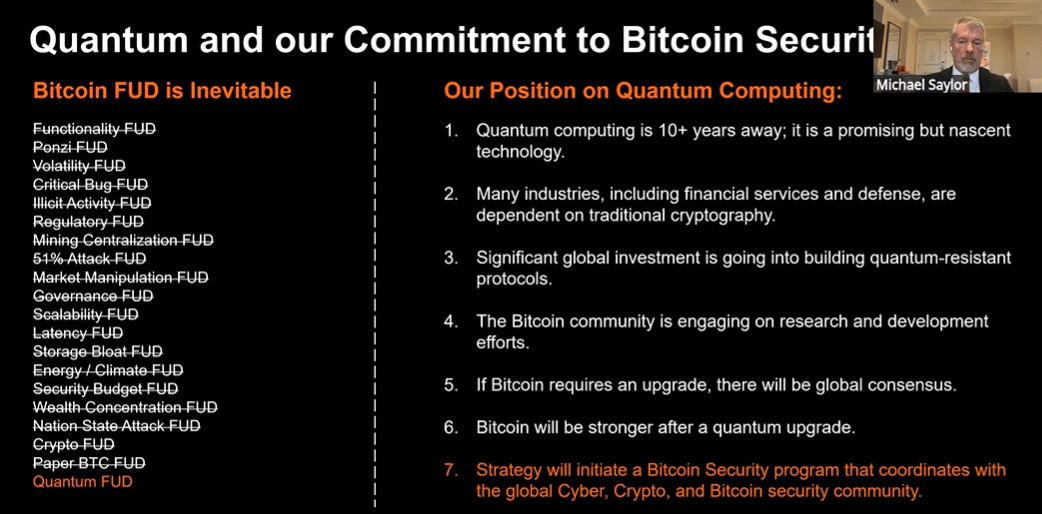
Saylor emphasized collaboration with global cybersecurity, crypto security, and Bitcoin security communities to coordinate research and develop responses to these potential risks.
"Given our substantial role as a Bitcoin holder, it's both reasonable and necessary for us to spearhead this initiative," Saylor stated. "We aim to engage responsibly and ensure alignment with the global cyber crypto and Bitcoin security communities, leveraging the wealth of expertise available. Consensus and solutions will emerge at the right time in a responsible manner."
The current elliptic curve digital signature algorithm (ECDSA) used by Bitcoin could be vulnerable to Shor's Algorithm as quantum computing progresses.
Research from Deloitte indicates that approximately 25% of Bitcoin is at risk, particularly holdings in early P2PK and reused addresses with exposed public keys.
While acknowledging the potential threat of quantum computing, Saylor dismissed it as part of ongoing "FUD" that Bitcoin has previously overcome, urging investors not to panic or make hasty technical changes that might introduce new vulnerabilities.
"The consensus is that a significant threat is likely 10 or more years away," he said. "While promising, quantum technology remains in its infancy. Numerous global communities are already working on quantum-resistant protocols."
"If an upgrade is needed for Bitcoin, it will arise from global consensus. Currently, there is no widespread agreement that existing cryptographic libraries are at risk," Saylor noted. "Approaching these risks requires careful timing—not too soon or too late—to ensure appropriate technological solutions are implemented."
"Bitcoin will become stronger post-quantum upgrade. It is inherently upgradeable and can be enhanced further," he added.
Some analysts predict quantum-capable computers could surface between 2027 and 2030, prompting responses from the crypto ecosystem, such as developer proposals like BIP 360 for quantum-resistant Bitcoin features.
The perceived quantum risks have led some investors to adopt defensive strategies. Jefferies analyst Christopher Wood has removed Bitcoin from his portfolio due to these concerns.