

Bitcoin's Resilience Amidst Trump's Tariff Turmoil
Bitcoin's Resilience Amidst Trump's Tariff Turmoil
President Trump's unpredictable trade policies in 2025, marked by frequent tariff threats, reversals, and extensions, continue to roil financial markets. Many anticipate a significant economic slowdown in the third quarter of 2025. However, Bitcoin has demonstrated a surprising resilience, seemingly decoupling from the tariff-related news.
Tariff Volatility and Market Reactions
Trump's recent actions include imposing reciprocal tariffs on 14 countries, ranging from 25% to 40%, while simultaneously extending a pause on broader tariffs until August. These actions, while viewed by some as negotiating tactics, have created significant uncertainty for global businesses.
The impact on traditional markets has been notable. For example, Canada's immediate repeal of its Digital Services Tax followed the US's suspension of trade negotiations. This led to gains in the Dow Jones, Nasdaq, and S&P 500 indices. However, the 10% minimum tariff on most US imports remains a significant burden, raising consumer costs and squeezing business profits.
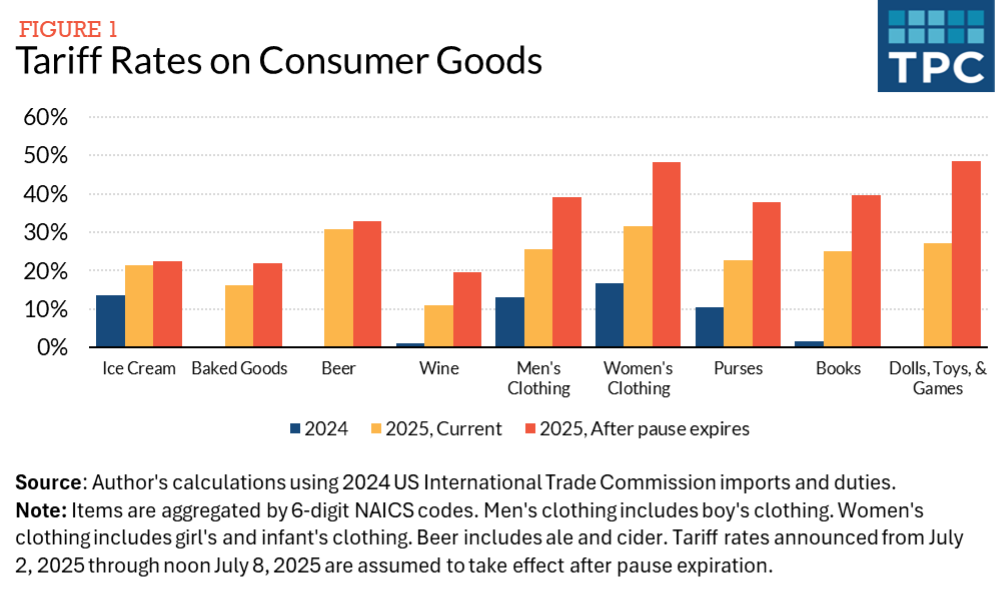
The Tax Policy Center reports that tariffs are projected to soar in early August, impacting various goods significantly. This increase, pushing the average tariff rate to 18%, the highest since 1934, will undoubtedly increase consumer prices and reduce profit margins, disproportionately affecting lower- and middle-income households.
Bitcoin's Decoupling and Price Surge
While initially impacted by Trump's tariff announcements (with Bitcoin dipping below $80,000 in February 2025), Bitcoin has recently shown resilience. Its recent surge to a new all-time high above $118,000 following Monday's tariff announcement contrasts sharply with the negative performance of major US stock indices.

Analysts suggest that Bitcoin's decoupling is due to its increasing perception as a macro hedge against inflation and market uncertainty, driven by its scarcity and decentralized nature.
Blockchain's Role in Supply Chain Resilience
Beyond Bitcoin's price performance, blockchain technology offers practical solutions for navigating trade disruptions. Its transparent and immutable nature can streamline supply chains, reducing opacity and enhancing traceability. This increased visibility enables businesses to adapt more quickly to regulatory changes, identify bottlenecks, and reduce fraud.
Codeum, a leading blockchain security and development platform, offers comprehensive services including smart contract audits, KYC verification, custom smart contract and DApp development, tokenomics and security consultation, and partnerships with launchpads and crypto agencies. These services are invaluable in building secure and resilient blockchain solutions for businesses operating in volatile markets.
In conclusion, Bitcoin's unexpected resilience and blockchain's potential to address supply chain vulnerabilities highlight the evolving role of cryptocurrency in a turbulent global economy.